
 Posted by

I chose to connect my STEAM project idea to unit 12 objective “Analyze the effects of disease on function and structure of the respiratory system”
Lung cancer accounts for one third of all cancer related deaths in the United States. (Detterbeck et al., 2015, pp. 495-504) it is also the leading cancer-related death in the United States for both men and women. (Duma et al., 2019)
Environment and lifestyle factor into the development of lung cancer. While cigarette smoke is most important accounting for 85% to 90% of lung cancers. The development is also associated with carcinogenic factors, such as asbestos and others. As well as environmental toxins such as second hand smoke, radon, and metals like arsenic, chromium, and nickel. (Duma et al., 2019) the risk of cancer also increases if there was a first degree family member with lung cancer. It also increased further if two or more had lung cancer. (Detterbeck et al., 2015, pp. 495-504)
Central and south america and most of africa are estimated to be lower. However developing countries lack a centralized reporting system. The World Health Organization (WHO) estimates that lung cancer will continue to rise worldwide. (Duma et al., 2019)
In the United States lung cancer is lower in people younger than 40 years of age. It also peaks at 65 to 84 years, with the median being 71 years. Approximately 90% of diagnosis and deaths are people over 55 years of age. (Duma et al., 2019)
There are two main forms of lung cancer, small cell lung cancer (SCLC) and non-small cell lung cancer (NSCLC). SCLC accounts for 15% of all lung cancers while NSCLC accounts for the other 85%. For NSCLC the 5 year survival rate is low. For stage IB it is 68%, as for stage IV it is 0 to 10%. With 19% cases in women and 9% in men who were non smokers. (Duma et al., 2019) This makes the survival rate 17% (Detterbeck et al., 2015, pp. 495-504)
NSCLC is classified into three main categories. Adenocarcinoma, squamous cell carcinoma, and large cell cancer. (Duma et al., 2019) it is critical to differentiate these because they respond differently to certain chemotherapeutic agents. Also the immunohistochemical stains and genetic characteristics can facilitate the distinction between the subtypes. (Detterbeck et al., 2015, pp. 495-504) less common types of NSCLC include adenosquamous carcinoma, sarcomatoid carcinoma, salivary gland carcinoma, carcinoma tumor, and unclassified carcinoma.(National Cancer Institute, 2025)
Adenocarcinoma is the most common type accounting for 40% of lung cancers. It arises from alveolar cells located in the smaller airways epithelial cells. It tends to express immunohistochemical markers such as TTF-1 and napsin A. The WHO also recognizes early stages of lung cancers as adenocarcinoma in situ. Which are preinvasive lesions. This adenocarcinoma is a lepidic pattern with a diameter of less than 3cm. Minimally invasive adenocarcinoma is with a diameter of more than 3cm but less than 5cm.
Squamous cell carcinoma represents 25% to 30% of lung cancers. They usually arise from cells located in the airway of the epithelium. They also have immunohistochemical markers such as CK5, CK6, p40, and desmoglein-3.
Large cell cancer accounts for only 5% to 10% of lung cancer. It is declining due to newer immunophenotyping. Which allows for better classifications. The tumors are poorly differentiated and composed of large cells with abundant cytoplasm and large nucleoli. (Duma et al., 2019)
The common symptoms are chest discomfort and pain, a persistent cough, trouble breathing, wheezing, blood in the sputum, hoarseness, loss of appetite, weight loss, fatigue, trouble swallowing, and swelling in the face and/or in the veins of the neck. (National Cancer Institute, 2025)
Often NSCLC is not diagnosed until advanced stages. Diagnosis also requires determination of the extent of the tumor to define the TNM stage. (Duma et al., 2019) T representing the primary tumor, N the regional lymph nodes and M the distant metastasis. (Detterbeck et al., 2015, pp. 495-504)
There are different stages and types of lung cancers. Starting with occult, the hidden stage 0. Stage 1, 2, and 4 these are divided into types A and B. while stage 3 is divided into types A,B, and C. (National Cancer Institute, 2025)
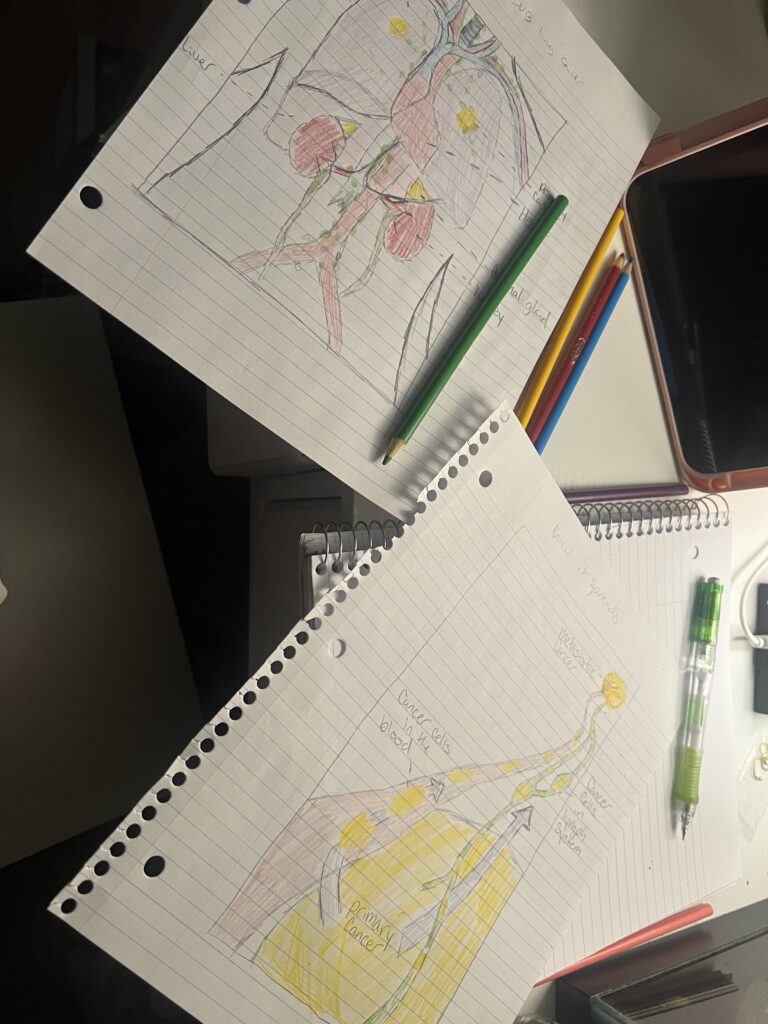
As for the art project I drew the diagrams for NSCLC at stage 4 type B. In stage 4 the tumor can be any size and the cancer may have spread to the lymph nodes. One or more of these three could have been found as well. There are more than just the primary tumor in the lungs. And/or the cancer was found in the fluid around the lungs or heart. And/or the cancer has spread to one place in an organ or tissue not near the lungs. Such as the brain, adrenal glands, kidney, liver, bones, or lymph nodes not near the lungs. I also drew how it metastasizes to other organs of the body by entering the lymphatic and blood system. These diagrams helped me better understand the material I was learning and writing about. (National Cancer Institute, 2025)
Work cited
Detterbeck, F. C., Decker, R. H., Tanoue, L., & Lilenbaum, R. C. (2015). Practice of Oncology / Cancer of the Thoracic Cavity (4th ed., pp. 495-504). DeVita. https://journals.lww.com/oncology-times/Documents/DeVita_chapter_41_pages_495-504.pdf
Duma, N., M.D., Santana-Davila, R., & Molina, Julian R,M.D., PhD. (2019, August 1). NoneSmall Cell Lung Cancer: Epidemiology, Screening, Diagnosis, and Treatment. ProQuest. https://www.proquest.com/docview/2269873303?accountid=14470&sourcetype=Scholarly%20Journals
National Cancer Institute (2025, May 16). Non-Small Cell Lung Cancer Treatment (PDQ®)–Patient Version. https://www.cancer.gov/types/lung/patient/non-small-cell-lung-treatment-pdq#top