 Posted by
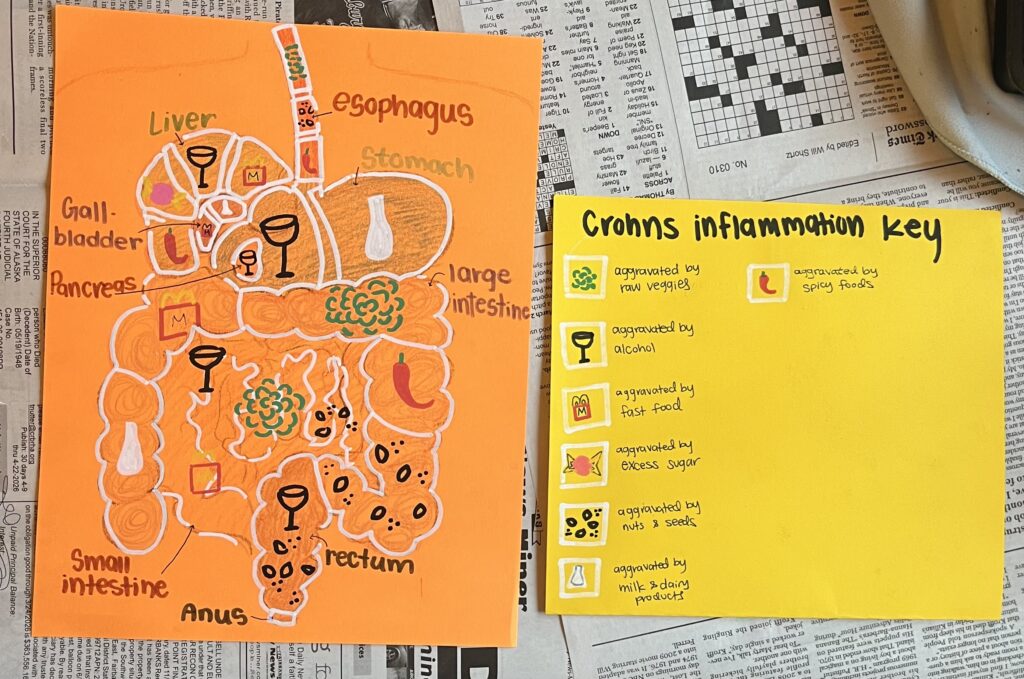
My Project is on Crohn’s Disease, and the impacts different foods have on those who have it. Crohn’s disease is a type of inflammatory bowel disease (IBD), that can affect “any part of the digestive tract”, from mouth to anus (Wagtmans, 1997). Before the 1960s, it was believed that it only truly impacted “the ileum and/or colon” (Wagtmans, 1997). Since then, many countries have seen a “rapid and recent rise in IBD” found all throughout the digestive tract (Trakman et al., 2022). Newer evidence suggests “processed foods and food additives may increase individuals’ risk for developing Crohn’s (Trakman et al., 2022). Especially the western diet, “rich in sugars, fats and proteins” is suspected to increase the chance of triggering Crohns, as these foods have a “stronger influence on the intestinal microbiome” compared to more plant based diets (Wellens et al., 2021). Severe Crohns can cause fistulas, inflammation, and ulcers anywhere along the digestive tract, which can be detrimental to a person’s digestive function (Baumgart & Sandborn, 2012). During flareups, foods including dairy products, caffeine, alcohol, fast food, whole nuts, and fruits with seeds can increase symptoms and significantly add to the severity of the flare up (Brown et al., 2011). My piece is made up of some of the more common food triggers for people with Crohn’s.
While inflammation, fistulas and ulcers can occur anywhere in the digestive tract, location varies on a case to case basis, so I decided to focus on 7 of the major digestive organs. The organs I focused on were the stomach, pancreas, liver, gallbladder, large and small intestine, and esophagus, to fulfill course objective 51; relate the stomach, pancreas, liver, gallbladder, large and small intestine, and esophagus to their functions. Fistulas, ulcers, and severe inflammation can completely mess up the function of any of the organs I listed, however, damage to some is considered worse than others.
The liver and the small intestine are the most important parts of the digestive tract (Unit 13 Small Intestine Anatomy lecture video min 0.08). The small intestine is the place where most of our digestion and absorption takes place and the liver has over 500 metabolic functions, and acts as a processing center (Unit 13 Small Intestine Anatomy lecture video min 0.16), (Unit 13 The Liver lecture video min 1.00). Damage to either of these organs can be detrimental. If bad symptoms prevail in the liver or small intestine, surgery is very likely. The pancreas is also important to your digestive health. The pancreas has both endocrine and exocrine functions, and is responsible for producing pancreatic juices, insulin and glucagon (Unit 13 Pancreas lecture Video min 0.05). Damage to the pancreas can lead to cirrhosis. The large intestine is less important than the small intestine. It has similar nutrient absorption functions, but to a much lesser degree (Unit 13 Large Intestine and Appendix Lecture Video Min 0.40). It largely stores waste until elimination. The stomach is important, but if the damage is too severe it can be removed, with continued digestive function of the patient with medical assistance (Unit 13 The Stomach lecture video min 0.13). The stomach is where proteins begin to be denatured (Unit 13 The Stomach lecture video min 0.32). The esophagus acts as a passageway for food to the rest of the digestive system. The Esophageal glands secrete mucus to aid in bolus movement (Unit 13 Pharynx, Esophagus, and Heartburn Lecture Video min 0.47). Sores in the esophagus make swallowing extremely painful. With this in mind, it is still possible for patients to function without their esophagus through a pathway rearrangement surgery. So as painful as damage to the esophagus is, it’s not considered as serious as other organs. Finally is the gallbladder. The gallbladder functions to store and concentrate bile (Unit 13 Gallbladder and Parasites lecture video min 0.20). Damage to the gallbladder is considered the least serious, as the body can function without one (Unit 13 Gallbladder and Parasites lecture video min 0.28).
By paying attention to which foods aggravate flareups, we hope to keep damage to the digestive tract at a minimum. In my project, I put each “bad” food within the specific organ it aggravates. I think this is a cool way to visualize this concept of inflammatory food groups for this disease.
Works Cited
Baumgart, D. C., & Sandborn, W. J. (2012). Crohn’s disease. The Lancet, 380(9853), 1590–1605. https://doi.org/10.1016/s0140-6736(12)60026-9
Brown, A. C., Rampertab, S. D., & Mullin, G. E. (2011). Existing dietary guidelines for Crohn’s disease and ulcerative colitis. Expert Review of Gastroenterology & Hepatology, 5(3), 411–425. https://doi.org/10.1586/egh.11.29
Trakman, G. L., Lin, W. Y. Y., Hamilton, A. L., Wilson-O’Brien, A. L., Stanley, A., Ching, J. Y., Yu, J., Mak, J. W. Y., Sun, Y., Niu, J., Miao, Y., Lin, X., Feng, R., Chen, M., Shivappa, N., Hebert, J. R., Morrison, M., Ng, S. C., & Kamm, M. A. (2022). Processed Food as a Risk Factor for the Development and Perpetuation of Crohn’s Disease—The ENIGMA Study. Nutrients, 14(17), 3627. https://doi.org/10.3390/nu14173627
Wagtmans, M. (1997). Crohn’s disease of the upper gastrointestinal tract. The Netherlands Journal of Medicine, 50(2), S2–S7. https://doi.org/10.1016/s0300-2977(96)00063-0
Wellens, J., Vermeire, S., & Sabino, J. (2021). Let Food Be Thy Medicine—Its Role in Crohn’s Disease. Nutrients, 13(3), 832. https://doi.org/10.3390/nu13030832