Posted by
By Juliet Trafton
What is achondroplasia, you may ask? Achondroplasia is a type of skeletal dysplasia, which is a group of disorders that affect bone growth. Achondroplasia is the most common type of skeletal dysplasia and results in short stature. It is also known as dwarfism. Achondroplasia affects about 2.3-7.6 births out of 10,000 (Panda et al., 2014).
There are many ways of diagnosing achondroplasia, and most of them are visual. The most visually obvious sign of achondroplasia is that a person with achondroplasia’s long bones are all shortened. The bones most affected by this, though, are the proximal limbs (Panda et al, 2014). This disproportionate shortening of the proximal bones specifically is also called rhizomelia. Another visual sign is macrocephaly, which is an enlarged head. Babies’ heads will be large at birth and will stay large through adulthood as well. There is also midfacial retrusion present in people with achondroplasia, which presents as a distinct facial structure. This happens because the cartilaginous bones of the face are underdeveloped, so the bridge of the nose is flat and there is a short nasal spine (Pauli, 2019). One final visual indicator of achondroplasia is looking at a person’s hands. When looking at the hands of someone with achondroplasia, their hands will often be in what’s considered a “trident formation” (Panda et al., 2014). This is because the second and third fingers are widely separated. The hand bones are also thicker and more tubular than in someone without achondroplasia. To conclude, there are many visual signs of achondroplasia, including bone length, cartilaginous bone structure in the face, and the way the bones are structured in the hand.
Achondroplasia is caused by mutations in fibroblast growth genes, specifically fibroblast growth factor receptor type 3 (FGFR3) (Pauli, 2019). Of the four fibroblast growth factors in humans, FGFR3 is most often found on chondrocytes that partake in the production of cartilaginous bone. To be completely honest, I did not fully understand the exact words, but to the best of my knowledge, FGFR3 binds to other growth factors that act as “ligands”, which makes the protein “silent” (Pauli, 2019). This silence prevents the negative regulation that FGF3 would otherwise give off. Achondroplasia then happens when the FGFR3 receptors are all left to their own devices and send out signals to inhibit the process of forming cartilaginous bone. This mutation then leads to a person who has achondroplasia.
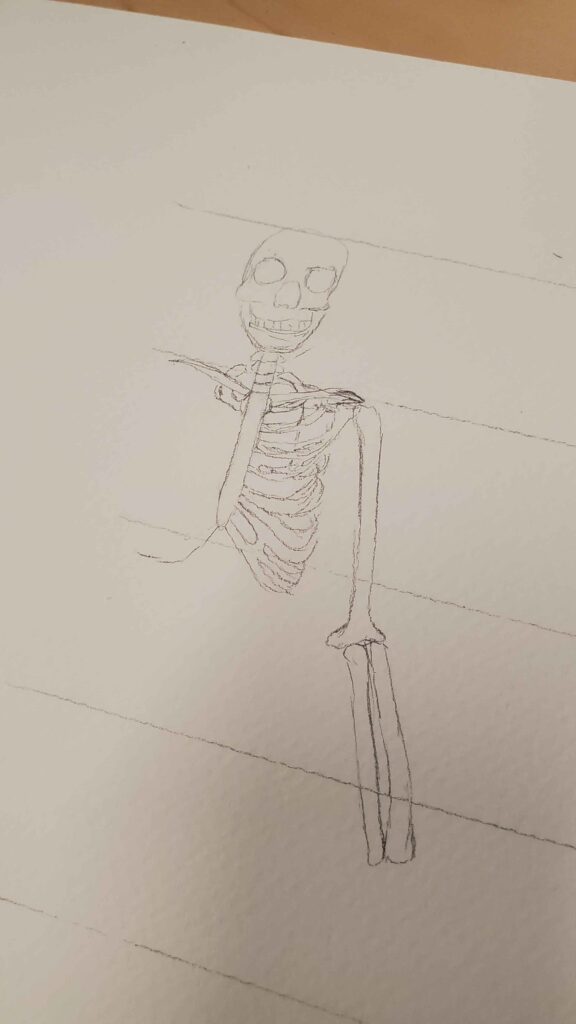
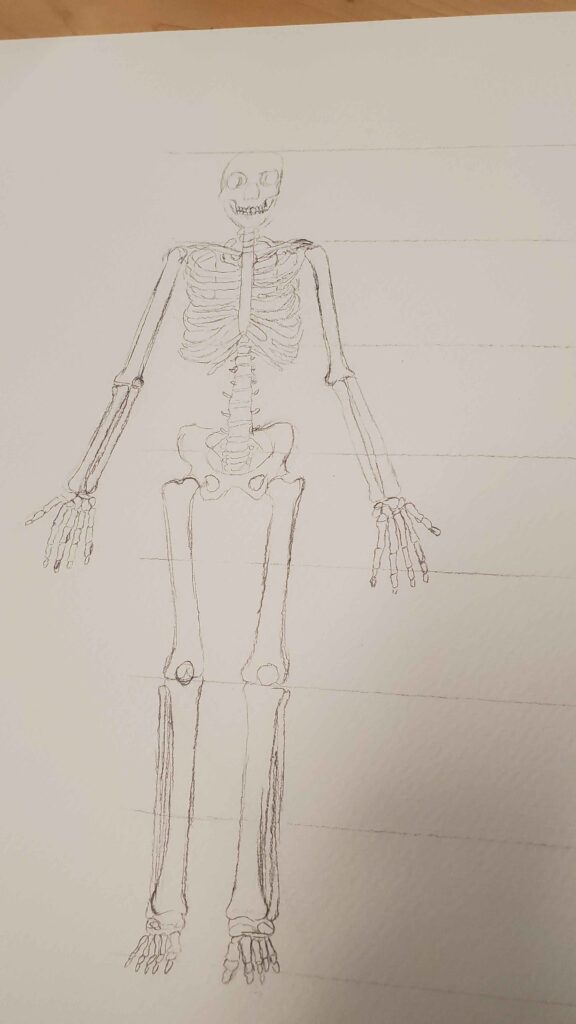
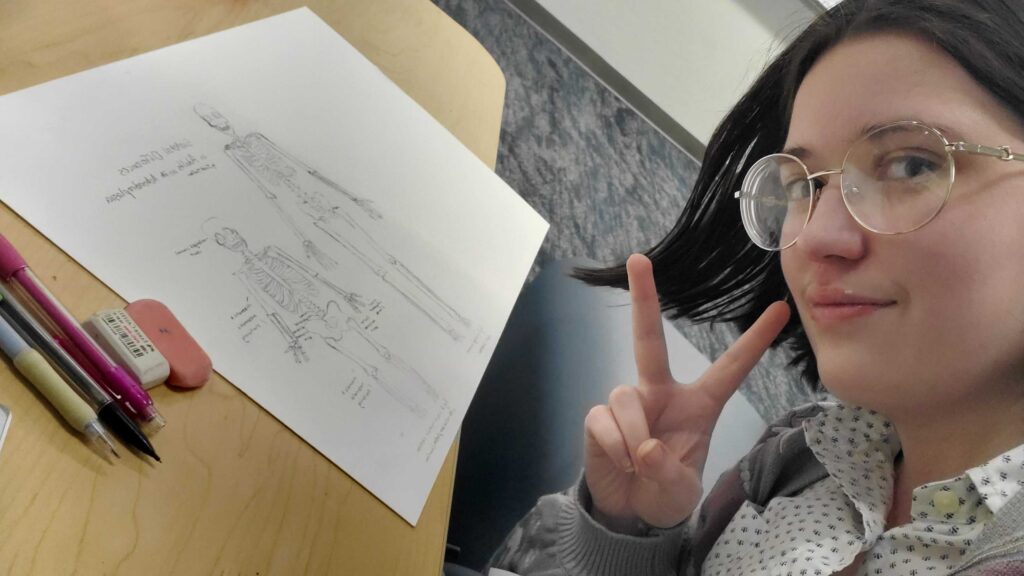
This project was made with just paper and pencil (and lots of erasing). In art, one of the basic things that an artist must learn is proportion. The average human person is 7-7.5 heads tall at about 5’6”, and then the torso is about two heads, then the femur is another two heads, and the tibia and fibula are the last two heads. An average person with achondroplasia is around 5 heads tall at about 4’2”. This person’s torso is about two heads tall, and then the femur is one head and the tibia and fibula are the last head. From the artistic perspective, a person with achondroplasia has legs that are about half as long as an average person’s. An average human’s arms are about three heads long, and a person with achondroplasia’s arms are about two heads long. So the ratio is different between the legs and arms when comparing an average person to a person with achondroplasia.
[disclaimer: differences not labeled in the drawing are likely a result of the failing of the artist (me) rather than unlabeled differences]
Panda, A., Gamanagatti, S., Jana, M., & Gupta, A. K. (2014). Skeletal dysplasias: A radiographic approach and review of common non-lethal skeletal dysplasias. World journal of radiology, 6(10), 808–825. https://doi.org/10.4329/wjr.v6.i10.808
Pauli, R. M. (2019). Achondroplasia: A comprehensive clinical review – orphanet journal of rare diseases. SpringerLink. https://link.springer.com/article/10.1186/S13023-018-0972-6#citeas
Here is the drawing itself, and below are progress pictures and a photo of myself near the end of the process.