
 Posted by
Topic Introduction
In this STEAM project, I will present how mitosis, my chosen objective, relates to the differentiation of osteoprogenitor cells. We will see what these cells are, what they do, and what causes them to mature through different biological pathways. For the art element of this project, I will illustrate what specific factors cause the osteoprogenitor to differentiate.
Background
Osteoprogenitor cells are crucial for maintaining bone health regrowth (Christiansen et al., 2023). These cells come from mesenchymal cells in the bone marrow, and are a stem cell found in the periosteum layer of the bones. They are able to mature into different cells, which can be osteoblasts, osteocytes, chondrocytes, fibroblasts, and adipocytes. This project will look into what factors decide which cell will form from an osteoprogenitor cell. My main focus will be what factors change the cellular maturation pathway that an osteoprogenitor cell will take, and tie this into the topic of mitosis that was covered earlier this semester.
A study, (Reeves et al., 2024), shows that these cells are far more active in younger organisms (they studied mice). Their study gave evidence that this age-related lessened state of regenerative tissues may be reversed under certain conditions. This study suggests that hormones play a role in the growth and differentiation of osteoprogenitor cells. As we have learned in this class, testosterone and estrogen are produced less as a body ages, and this leads to lower bone density in many cases. This supports the other studies cited in this report that osteoprogenitor cells function and differentiate based on different cues and factors as will be covered in greater detail in the next section.
Factors of Differentiation
Chemical and physical cues are recognized to influence the differentiation of osteoprogenitor cells (Manokawinchoke et al., 2025). An example of these cells responding to physical stress is when a bone breaks. These stem cells will become activated, and produce osteoblasts (some of which will become osteocytes) in order to grow new bone tissue. A group of proteins that is very important to cellular growth and differentiation all throughout a body is transforming growth factor beta (TGF-beta). These proteins act as signalers to developing cells, helping decide what said cells will mature into. Other factors that can cause these stem cells to differentiate are: growth factors: bone morphogenic proteins (BMPs), fibroblast growth factors (FGFs), PDGF-BB; hormones such as insulin; transcription factor proteins: Runx1 and Runx2; physical stress; and cytokines (TGF-beta). (Wang et al., 2012)
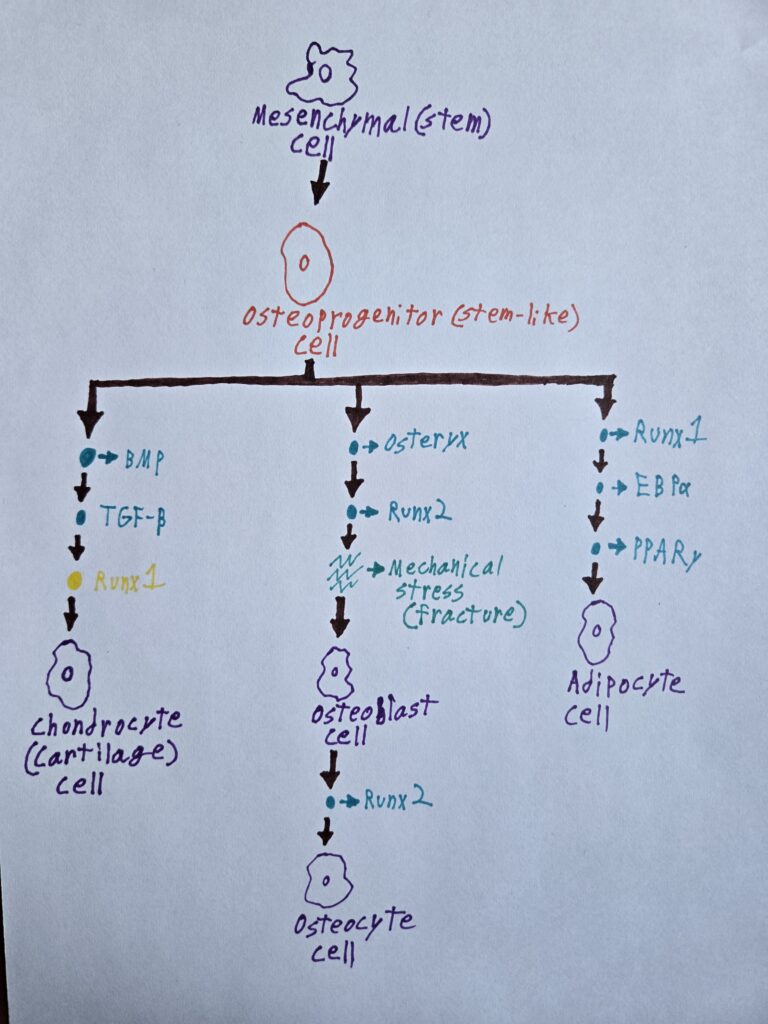
Figure 1. An example of the maturation pathways that an osteoprogenitor cell (beginning its life as a mesenchymal stem cell) can take. Important growth factors are listed, though the full scale of GFs used in this process are beyond the scope of this project. Note: osteoblast cells are capable of maturing further into osteocytes when fully embedded in the matrix that it secretes. Osteoblasts are typically found at the surface of the bone.
Typically, this differentiation will happen after mitosis. Even though mitosis may not directly decide what an osteoprogenitor cell will mature into, it is still a very important process to the function of these stem cells. Mitosis allows osteoprogenitor cells to replicate, meaning that there will always be some available to begin new bone growth or other functions.
It is important to note that, during mitosis, transcriptional factors in the cellular chromatin are, in a way, “reset” (Beerman, Rossi, 2015). This allows the cell to mature into anything (appropriate for the specific stem cell, osteoprogenitors in this case). Mitosis results in cells that in a neutral state when considering which of their transcription factors are activated. Activation of these factors, determining, for example, whether TGF-beta will be transcribed or not. Consider that mitosis “sets the stage” for stem cell differentiation. The daughter cells will not be set to code for any specific protein. They will be capable of doing what the body needs.
Conclusion
Mitosis causes a cell to grow into two identical daughter cells. These cells, stem cells in the case of this study, area ready to mature into any one of a handful of different cells, be it an osteocyte, osteoblast, or other. Differentiation is not directly influenced by mitosis, or is the end result of the maturation of a stem cell. Rather, mitosis produces stem cells that are ready to mature into what they need to.
Sources
van Dijk Christiansen, P., Andreasen, C. M., El-Masri, B. M., Laursen, K. S., Delaisse, J.-M., & Andersen, T. L. (2023). Osteoprogenitor recruitment and differentiation during intracortical bone remodeling of adolescent humans. Bone, 177, 116896. https://doi.org/10.1016/j.bone.2023.116896Links to an external site.
Reeves, J., Tournier, P., Becquart, P., Carton, R., Tang, Y., Vigilante, A., Fang, D., & Habib, S. J. (2024). Rejuvenating aged osteoprogenitors for Bone Repair. eLife, 13. https://doi.org/10.7554/elife.104068Links to an external site.
Manokawinchoke, J., Limraksasin, P., Limjeerajarus, C. N., Limjeerajarus, N., Samaranayake, L. P., Egusa, H., & Osathanon, T. (2025). Mechanical force induces osteogenic differentiation of murine induced pluripotent stem cells via tgf‐β signalling. Orthodontics & Craniofacial Research, 28(5), 809–819. https://doi.org/10.1111/ocr.12933Links to an external site.
Wang, M.-K., Sun, H.-Q., Xiang, Y.-C., Jiang, F., Su, Y.-P., & Zou, Z.-M. (2012, May 26). Different roles of TGF-β in the multi-lineage differentiation of Stem Cells. World journal of stem cells. https://pmc.ncbi.nlm.nih.gov/articles/PMC3443709/ Beerman, I., & Rossi, D. J. (2015). Epigenetic control of stem cell potential during homeostasis, aging, and disease. Cell Stem Cell, 16(6), 613–625. https://doi.org/10.1016/j.stem.2015.05.009