 Posted by
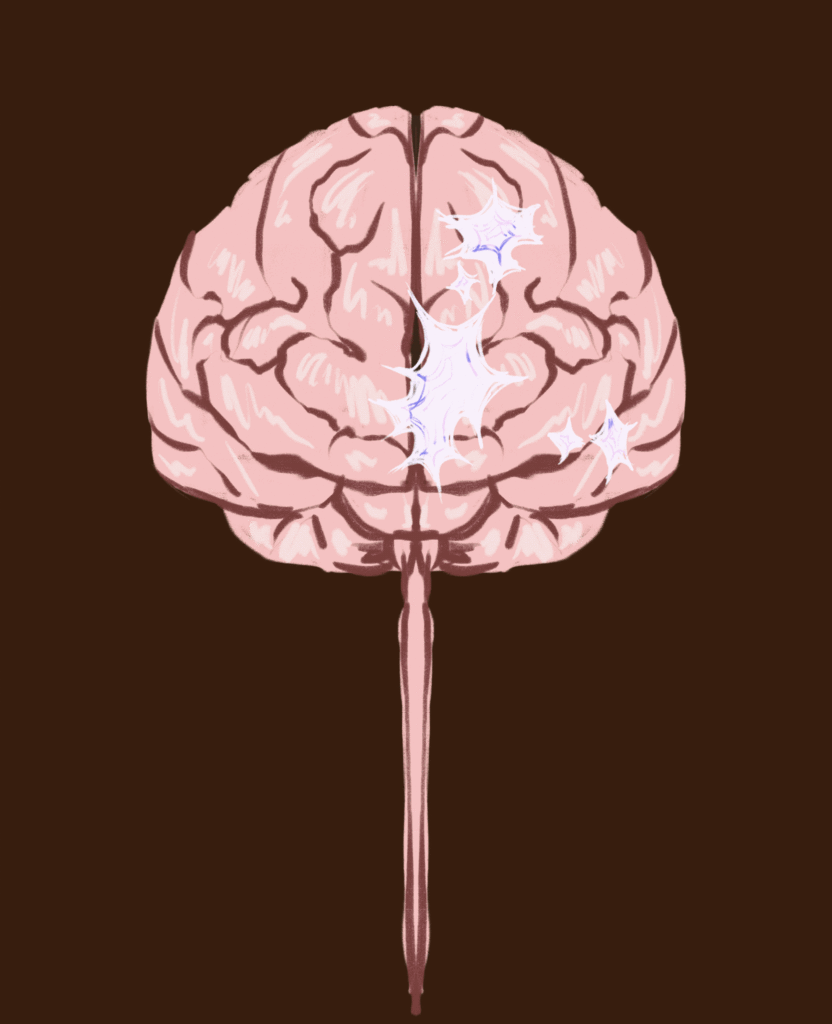
This STEAM project depicts the translation of emotion from the nervous system and endocrine system to the muscles and face. Starting with the brain, the emotion of sadness has been shown to correlate with isolated networks in the brain, with little activity in the cortex. In a study discussed by Arias et. al., activity in the brain is shown to be relegated mostly to areas in the innermost brain, such as the hippocampus, cerebellum, and amygdala. In comparison, when feeling fear or joy, these systems are consistently sending signals and messaging with the cortex. In the STEAM project, I have stylistically highlighted the parts of the brain that produce these signals.
In addition to the relative lack of communication across the brain, the endocrine system acts to adjust hormones and hormone receptors. A greater amount of cortisol is released, as well as changes in the thyroid system. There is also an increase in the hypothalamic corticotropin-releasing hormone (CRH) secretions. Hypersecretion of the CRH has been shown to cause hyperarousal, insomnia, and a reduction in feeding and libido, as described by Barchas JD et. al. Depression is characterized by the consistent change of these hormones.
The brain is then covered by the skull, acting as a protective layer.
The nervous system processes external stimuli and internal stimuli and works with systems in the body to react accordingly. An example in relation to this project would be if a person placed their hand on a hot stove, the CNS would communicate this to the brain, which would then act by releasing cortisol, a stress hormone, potentially causing the person to cry.
Beyond the central nervous system is the musculature system. Through action potentials, the skeletal system and musculature system work to move the body in a way consistent with the stimuli received from the CNS. In the example of the stove, the musculoskeletal system moves the hand away to stop from experiencing more pain and damage to the body. With facial expressions, the purpose of the muscles reacting and changing position of the face is debated, though it is generally assumed to be an evolved trait allowing for consistent understanding across communities. By changing the expression on our face, others are able to understand what we are feeling, whether or not they know why. In the expression depicted in the STEAM project, the subject’s lower brow is pressed inward, the lips are lowered at the corners, and the forehead is raised. This is due to the depressor anguli oris lowering the corners of the lips, and the mentalis pressing forward, pushing out the chin and lips into a frown and pout. In addition, the frontalis is raised up, raising and stretching the forehead, while the corrugator muscle presses the eyebrows together.
Finally, the skin and hair cover the rest of the body, acting as a flexible yet strong protective shield. When expressing sadness, the face will experience an increased blood flow, as the eyes get puffy and the face gets hot. This increased blood flow to the face extends to the brain, often encouraging an improvement in mood.
Juan A. Arias, Claire Williams, Rashmi Raghvani, Moji Aghajani, Sandra Baez, Catherine Belzung, Linda Booij, Geraldo Busatto, Julian Chiarella, Cynthia HY Fu, Agustin Ibanez, Belinda J. Liddell, Leroy Lowe, Brenda W.J.H. Penninx, Pedro Rosa, Andrew H. Kemp,
The neuroscience of sadness: A multidisciplinary synthesis and collaborative review,
Neuroscience & Biobehavioral Reviews,
Volume 111, 2020, Pages 199-228, ISSN 0149-7634, https://doi.org/10.1016/j.neubiorev.2020.01.006.
(https://www.sciencedirect.com/science/article/pii/S0149763418306146)
Adamov, L., Petrović, B., Milić, L., Štrbac, V., Kojić, S., Joseph, K., & Stojanović, G. M. (2025). Comparative analysis of electrical signals in facial expression muscles. Biomedical Engineering Online, 24(1), 17. https://doi.org/10.1186/s12938-025-01350-3Links to an external site.
Rohr, M., Folyi, T., & Wentura, D. (2025). “Hot” affect-related aspects in emotional information processing: The role of facial muscle responses in the direct and indirect processing of emotion categories. Emotion (Washington, D.C.), 25(1), 227–246. https://doi.org/10.1037/emo0001414
Barchas JD, Altemus M. Endocrine, Circadian and Behavioral Processes in Mood Disorders. In: Siegel GJ, Agranoff BW, Albers RW, et al., editors. Basic Neurochemistry: Molecular, Cellular and Medical Aspects. 6th edition. Philadelphia: Lippincott-Raven; 1999. Available from: https://www.ncbi.nlm.nih.gov/books/NBK28171/