
 Posted by
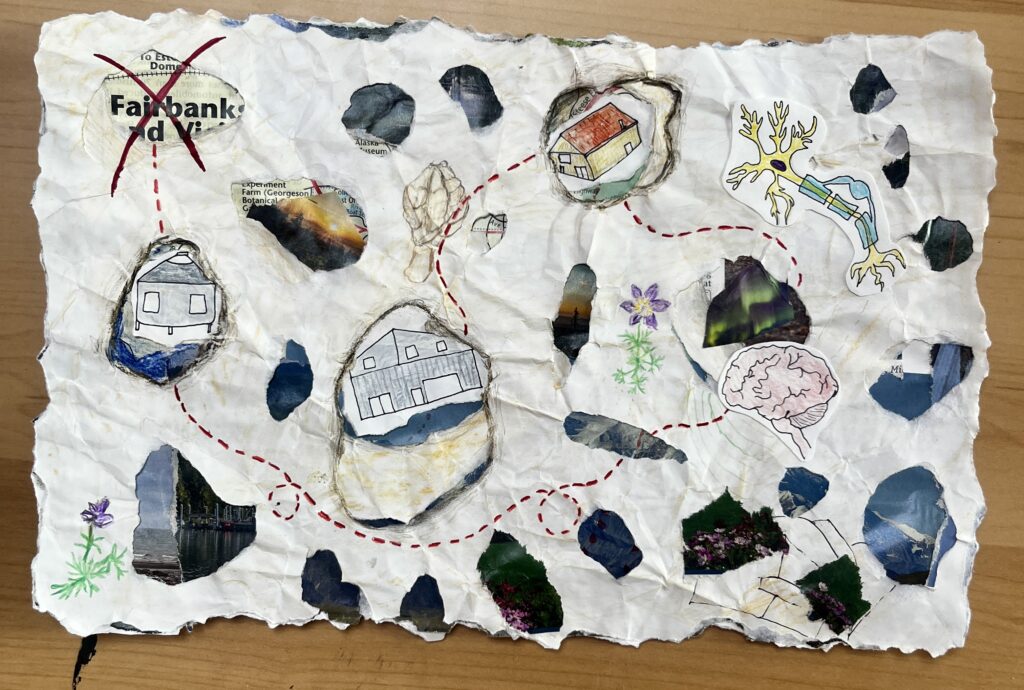
For my STEAM project, I chose to explore the objective Explain how sensory cells translate stimulus into action potentials. To interpret this concept artistically, I created a mixed-media map illustrating my connection to the various places I’ve lived—and how those places evoke a sense of comfort. This comfort is deeply sensory: rooted in sound, smell, and the emotional comfort of familiarity. Through this, I connected the neurobiological processes of sensory perception to my personal experiences of home.
Feeling the “vibe” of a place can be crucial to our own comfort. Scientists suggest that emotional regulation and perception of comfort often originate from early experiences in the home environment (Graham, Lindsay T. et al., 2015). These vibes are complex sensory inputs, influenced by environmental cues like chemosignals, and sounds. Some scientists study prosody, which is the influence of subtle changes in rhythm, pitch, and tone of somebody’s voice that carries emotional inflection. (Garance, S., 2024). Smell is also very important in contributing to the comfort of home. Research shows that chemosignals (such as scents released by humans and other scents) play an important role in emotion, conveying emotional states and influencing people’s perceptions without them even realizing. (de Groot, J. H., Smeets et al., 2012)
In neuroscience, our ability to pick up on these subtleties and smells are possible due to specialized sensory receptor cells that detect stimuli and translate them into action potentials which are electrical signals that the brain can interpret and react to. This process is called sensory transduction.
When a stimulus, (in the case of my project sound and scent in regards to home) reach a sensory receptor cell, this is the process of sensory transduction:
First–Reception: The receptor cell ( Mechanoreceptors for sound, and chemoreceptors for scents) detects a specific form of energy.
Second–Transduction: This stimulus energy changes the membrane potential of the receptor cell by opening ion channels (Usually Na⁺ or Ca++ ), making a graded receptor potential.
Third–Action Potential Generation: If this graded potential reaches the critical threshold, then the ion channels open, and an action potential is fired.
Fourth–Propagation: The action potential travels along the axon of the sensory neuron, to the peripheral nervous system, where it travels along until it reaches the central nervous system and it is processed within the brain.
In my artwork, I chose to represent this process both visually and literally with a classic dashed red line on the map. This route travels through my homes throughout my life, winding through a symbolic brain and neuron, illustrating the path of sensory input from reception to interpretation. I chose to collage images of Alaska underneath the map, but tear holes in the map so that one could see them, symbolizing that my sensory input of comfort is ongoing and continuous. Over the top of this collage I created the map, tearing holes, crumpling, and ripping the edges of it to give it a worn look. This was to further the idea of the emotional complexity of sensory perception.
Throughout this project I examined how my nervous system allows me to interpret what the comfort of home feels like, learning about how the translation of sensory input from the world around us into electrical signals the brain can understand. This project has helped me to better understand how people, places, smells, and vocal communication shapes my world and with it my comfort at home. Creating this project with the scientific backbone and artistic expression was a great opportunity to deepen my knowledge and understanding of neurology and my own personal emotional experiences.
Works Cited
- de Groot, J. H., Smeets, M. A., Kaldewaij, A., Duijndam, M. J., & Semin, G. R. (2012). Chemosignals communicate human emotions. Psychological science, 23(11), 1417–1424. https://doi.org/10.1177/0956797612445317
- Selosse, Garance, and Garance Selosse. “Feel the Vibes: Exploring Behavioral and Neural Correlates of Interoceptive Mechanisms in Vocal Emotion Communication.” Unige.ch, 2024, archive-ouverte.unige.ch/unige:181978, https://doi.org/10.13097/archive-ouverte/unige:181978. Accessed 11 June 2025.https://archive-ouverte.unige.ch/unige:181978.
3. Graham, L. T., Gosling, S. D., & Travis, C. K. (2015). The psychology of home environments: A call for research on residential space. Perspectives on Psychological Science, 10(3), 346-356. https://d1wqtxts1xzle7.cloudfront.net/69809163/e1efd49866d93d766eafa23149725491d8a2-libre.pdf?1631893356=&response-content-disposition=inline%3B+filename%3DThe_psychology_of_home_environments_a_ca.pdf&Expires=1750381780&Signature=U0Uq9bgmT4JqmlQfFLy14xo4AjYlcJqs-t-D1qg~QfZYQMxD~Ac~RmBoegGbtCXGuzFRQGnyP5YqYGq9-QybFrsEl1-1hjTAk2zRWFA8en-9RjNS8VWWxY4pcCPoq0lNqZCy3zf3lHbNlUTVyPoYnpQBezq2~YJ7jvo2Iu~hMSEJQWu6Pzz8alLd8eGWsW3CnyXB0S6rnvNWXCXv0J8AG8EqZyxWvbn8IQc1eygi3d4oCAIGSOq2WyylAcI5cDJlVF8eOuaphqdEEWUTCoLywReLcXTB8H7S8i37vStvi7k6cLcCDr~r1F-GWUn~t7O-Z~OWy1ojI5t3vBSQjZXOyw__&Key-Pair-Id=APKAJLOHF5GGSLRBV4ZA